The right provider is not simply the one that promises the most. It is the one that can explain what it will do, demonstrate how it delivers, and make its responsibilities clear before something goes wrong.
The last thing you want to hear when your business is already dealing with an IT problem is: "That's not included in our service."
Imagine your firm's email stops working during a critical client deadline. You contact your IT provider, only to discover that it monitors the system but doesn't handle the underlying problem. Another vendor manages the affected application, and neither company has clear responsibility for coordinating the resolution.
This is a hypothetical example, but it illustrates a real purchasing risk: the services you believe you're buying may not match the responsibilities the provider has actually agreed to perform.
Choosing a managed IT service provider (MSP) or managed cybersecurity provider involves more than reviewing credentials, comparing software packages, reading testimonials, and negotiating monthly fees.
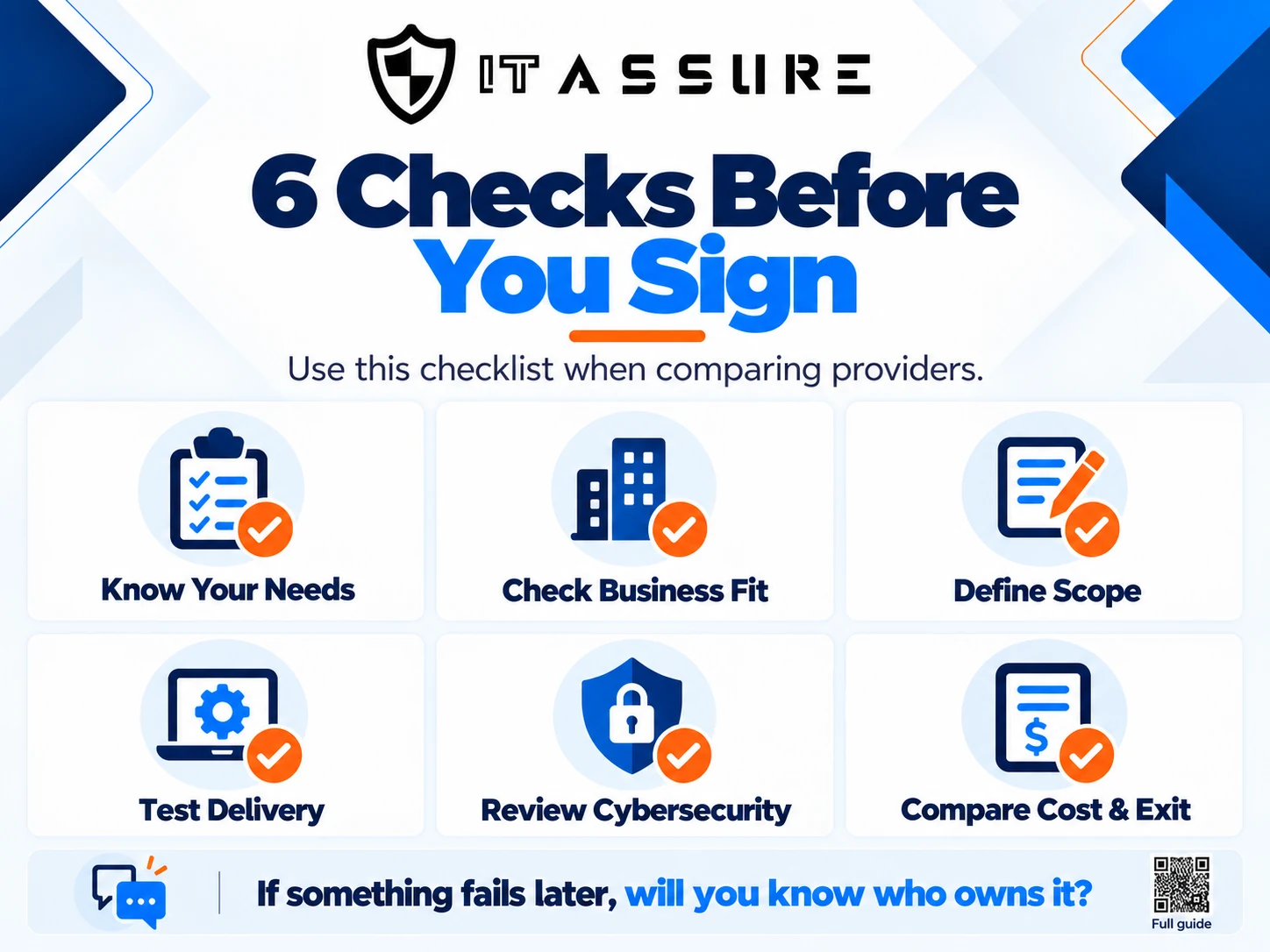
The better approach is to evaluate six things: what your business needs, whether the provider understands those needs, what it will be responsible for, how consistently it performs, how it manages cybersecurity, and what the complete relationship will cost.
These questions are useful whether you are hiring your first provider, replacing an existing one, or adding cybersecurity management without changing your current IT support.
1. Understand Your Own Needs Before Evaluating Providers
There is no shortcut around doing your own homework.
Before asking a provider what it recommends, spend time understanding what your organization actually needs help with.
What problems are you experiencing today? What business activities depend on technology working reliably? What concerns are you trying to address? What would a successful relationship look like?
For an accounting firm, the priorities might include uninterrupted access to tax applications, reliable remote work, protection of confidential financial information, and getting seasonal employees working quickly.
For a law firm, the priorities may include maintaining access to case management systems, protecting client documents, securing communications, and ensuring that deadlines aren't disrupted by preventable technology problems.
You don't need to understand every technical detail. But you should know which business outcomes matter and where uncertainty exists.
Know Which Service You Actually Need
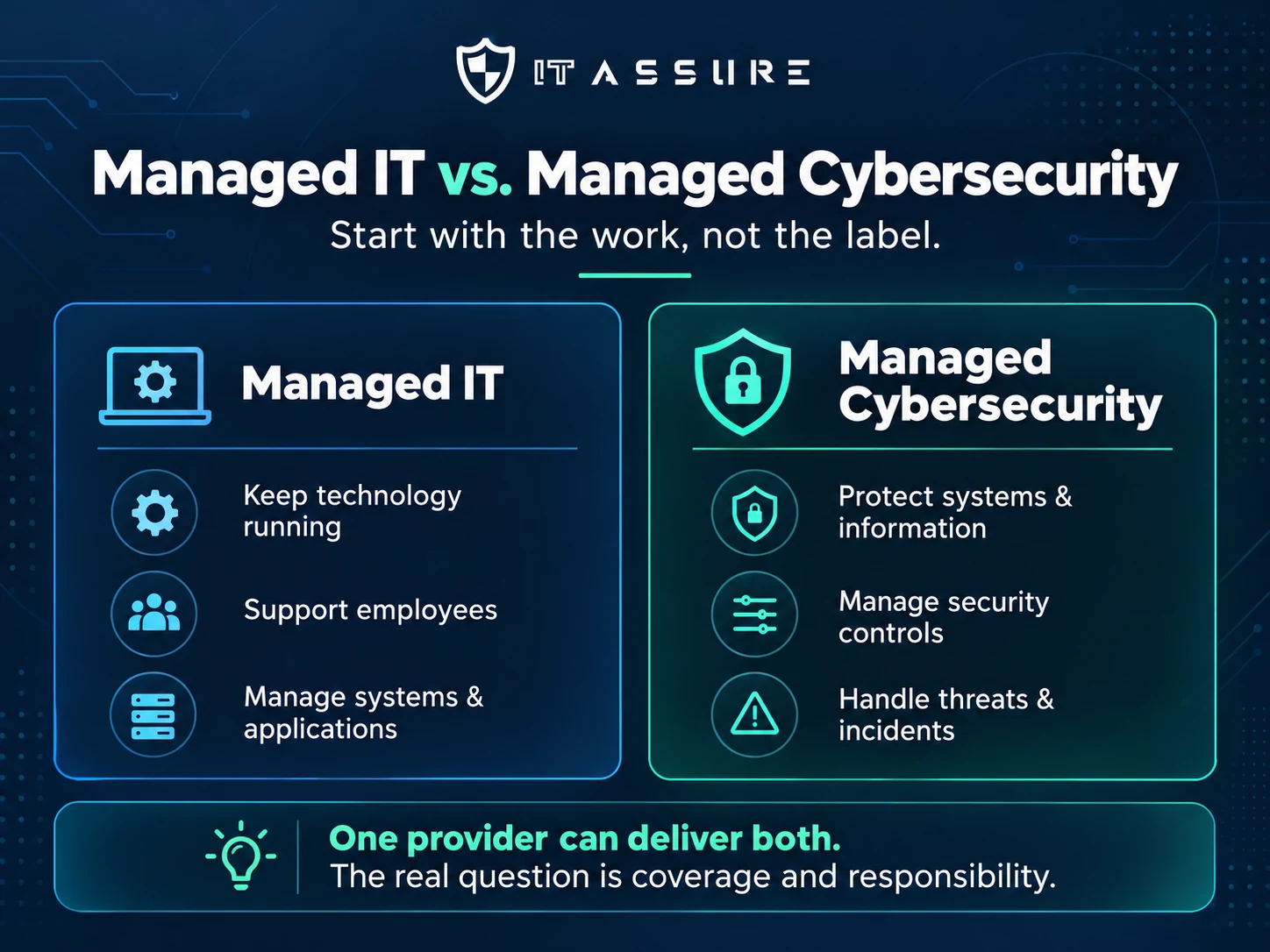
Managed IT and managed cybersecurity are related, but they are not necessarily the same service.
Managed IT services generally focus on operating and supporting technology: computers, networks, cloud systems, business applications, employee support, maintenance, and troubleshooting.
Managed cybersecurity services focus on managing security protections: identity and access controls, endpoint security, threat detection, email protection, security monitoring, and other defined controls.
Some providers deliver both. Others specialize in one area. An organization may also use separate providers or retain an internal IT employee while outsourcing cybersecurity.
None of these arrangements is automatically better.
The important question is whether all necessary responsibilities are covered, including the work that crosses the boundaries between providers.
A firm with reliable IT support may not need to replace that provider to improve cybersecurity. Conversely, purchasing security software does not eliminate the need for someone to support the underlying IT systems.
Before requesting proposals, define the problems you want solved and the work you expect someone else to handle.
2. Determine Whether the Provider Understands Your Business
A provider may be highly competent yet still be a poor fit for your organization.
Technology expertise matters, but understanding how your business operates can be equally important.
A provider serving accounting firms should understand the operational pressure of filing deadlines, seasonal staffing, confidential client information, and specialized applications.
A provider working with law firms should recognize the importance of document confidentiality, matter-based access, deadlines, and maintaining reliable access to client records.
Industry experience can shorten the learning curve. But the number of similar customers a provider serves is not, by itself, proof of service quality.

Look Beyond Testimonials
Testimonials and online reviews are useful starting points. They can reveal how customers perceive responsiveness, professionalism, and service quality.
However, testimonials are generally selected or voluntarily supplied. They rarely explain what happens when something goes wrong.
Ask for evidence that is closer to the work you need performed.
For example, ask the provider to describe a problem it resolved for an organization similar to yours. What caused the problem? How was it investigated? What was done to resolve it? What changed afterward to reduce the chance of recurrence?
A credible provider should be able to explain its approach without disclosing confidential customer information.
Evaluate Communication, Not Just Technical Ability
Ask the provider to explain a technical issue in language your management team can understand.
Can it distinguish the business consequences from the technical symptoms? Can it describe the available options, the recommended action, the costs, and the decisions your organization must make?
You shouldn't need to become a technology expert to understand an important business decision.
Clear communication matters particularly when incidents, costs, risks, or conflicting priorities require management involvement.
3. Establish Exactly What the Provider Will—and Won't—Do
Broad promises such as "We handle all your IT" may sound reassuring, but they don't establish a reliable service arrangement.
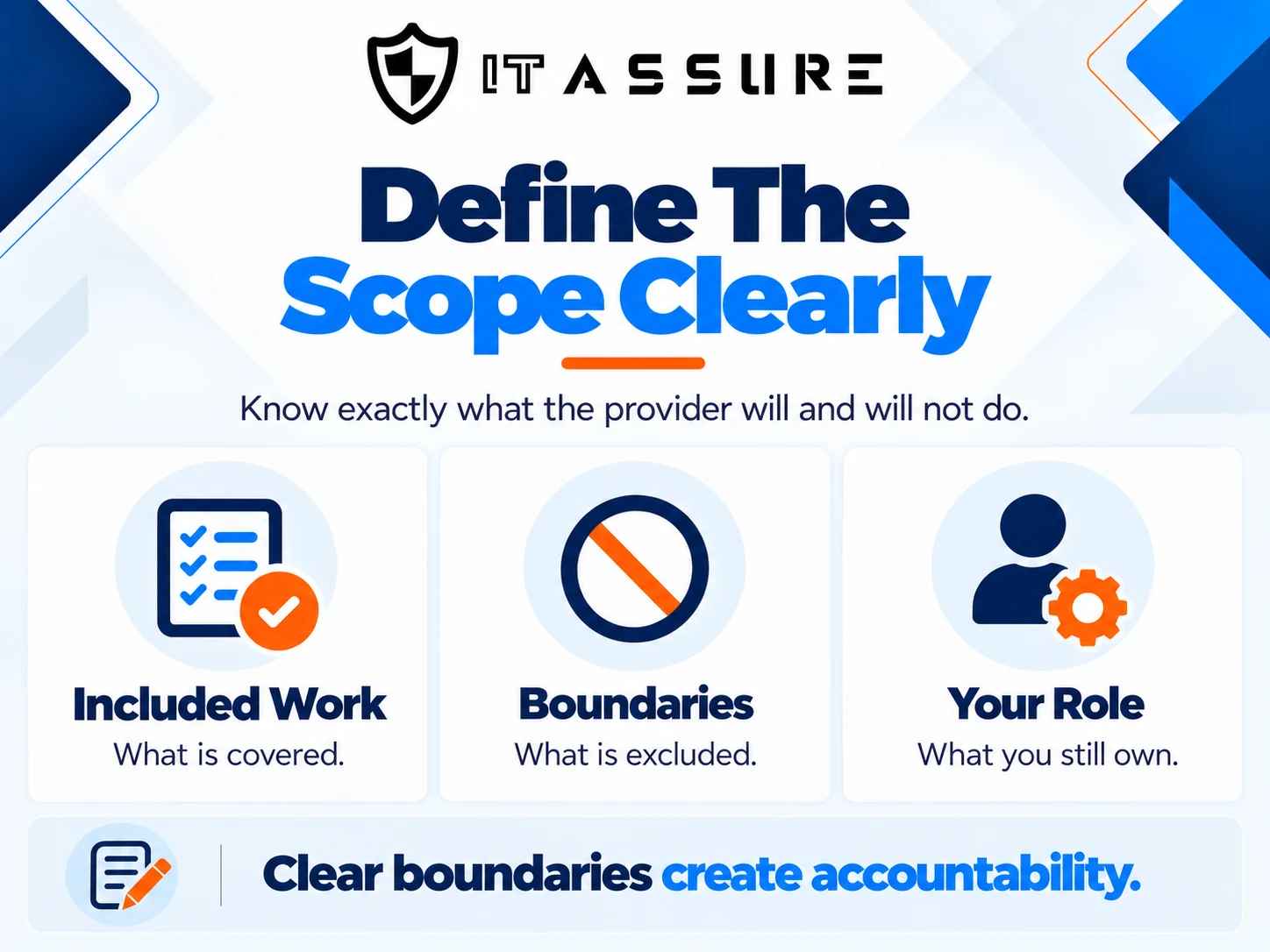
The provider should clearly explain the work included in its service, the work excluded, and the responsibilities that remain with your organization or another vendor.
Clear service boundaries are not a weakness. They are a foundation for accountability.
For example, a provider might monitor backups and notify you when they fail. Another provider may investigate failures, correct routine problems, and periodically test whether data can actually be restored.
Both may advertise "backup management," but the responsibilities are different.
The same distinction applies to software updates, cybersecurity monitoring, business applications, employee onboarding, and incident response.
Understand the Work Behind the Service
Find out what the provider expects to spend its time doing.
How much of its work is planned maintenance, monitoring, reviews, and prevention? How much involves responding to support requests or unexpected problems?
Effective support needs both.
Proactive work can identify problems before they disrupt the business. Responsive support remains essential because not every problem is preventable.
A useful provider should be able to explain how it balances these responsibilities within the service you are purchasing.
Understand Your Responsibilities, Too
A provider cannot make every business decision on your behalf.
Your organization may still need to approve user access, communicate employee changes, authorize purchases, approve disruptive maintenance, maintain appropriate insurance, or make decisions about accepted risks.
Ask the provider what it needs from your team to perform effectively.
For example, who tells IT when an employee joins or leaves? Who approves access to confidential client information? Who authorizes spending when a critical system needs replacement?
If responsibilities are unclear, important tasks can fall between the two organizations.
These expectations should appear in written agreements, service descriptions, or a clear responsibility matrix—not depend on what people remember from a sales meeting.
4. Find Out How Consistently the Provider Delivers
A strong sales presentation tells you what the provider intends to do.
A reliable delivery process helps you understand how that work will actually happen.
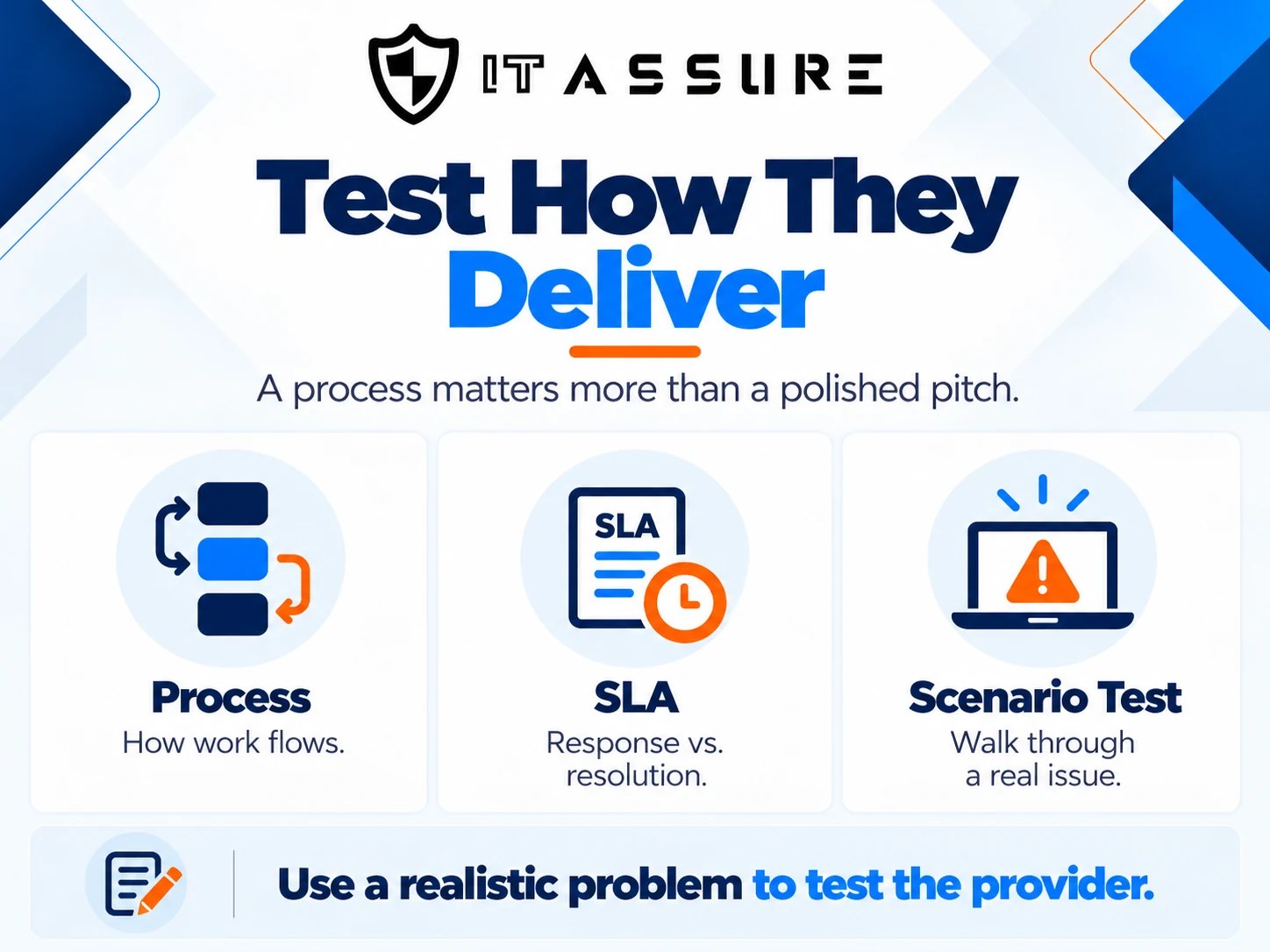
Ask about the provider's documented procedures, service standards, escalation process, communication practices, and reporting.
For example, when an employee reports that a business application isn't working, what happens next?
Who receives the request? How is its urgency determined? Who investigates it? When is the issue escalated? How is the customer kept informed? How does the provider know the problem was resolved?
Service-level agreements (SLAs) should help clarify these expectations.
Pay particular attention to the difference between a response time and a resolution time. A promise to respond within an hour does not necessarily mean the problem will be fixed within an hour.
Written procedures and attractive service-level commitments are useful, but they are not proof that a provider consistently follows them.
Give the Provider a Realistic Problem to Solve
One of the most revealing things you can do during an evaluation is present a situation your organization has experienced—or is particularly concerned about.
For example:
5. Apply Additional Scrutiny When Evaluating Cybersecurity
Cybersecurity deserves special attention because having protection installed does not necessarily mean that protection continues to cover everything it should.
Consider a hypothetical accounting firm with 25 employees.
Its provider has configured endpoint protection, multifactor authentication (MFA), and email security.
Three months later, the firm hires five more employees.
Who ensures the new employees and their computers are included in the intended protections?
Who checks that the protections remain active?
If a software agent stops reporting or an account is accidentally excluded, who investigates and corrects the problem?
These questions distinguish the purchase of security products from the ongoing management of cybersecurity.
Ask How the Provider Verifies Security Coverage
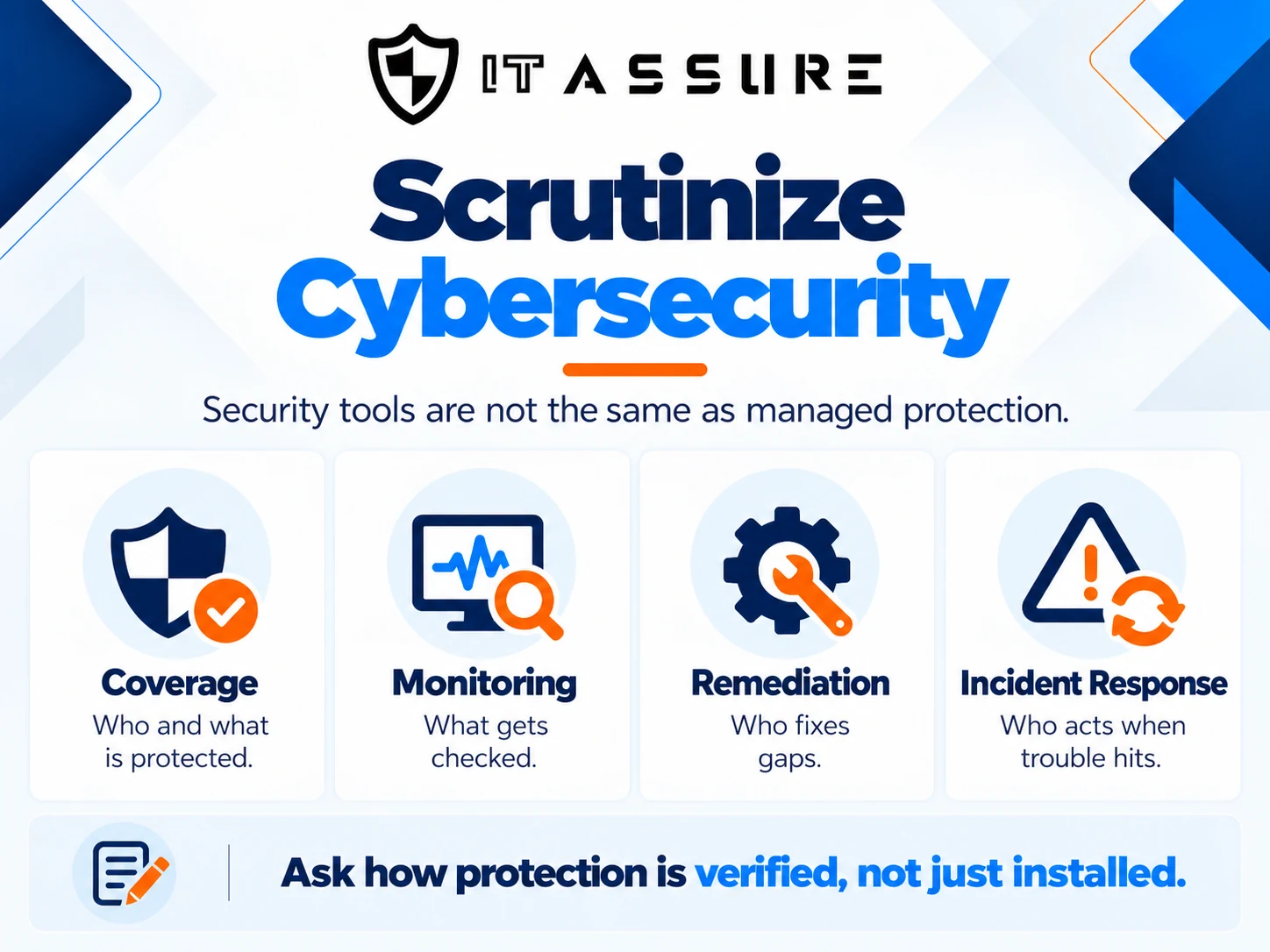
A security dashboard may report that every device known to that product is protected. But that doesn't necessarily tell you whether the product knows about every device that should be protected.
Ask how the provider establishes the expected list of employees, computers, accounts, and systems.
Then ask how that list is compared with what the security tools actually report.
This is especially important as organizations add employees, replace equipment, introduce applications, and change access permissions.
A meaningful security review should be able to identify not only whether a control is operating, but whether it covers its intended environment.
Distinguish Monitoring From Corrective Action
Security monitoring is valuable. But identifying a problem and correcting it are different responsibilities.
Ask what happens after a security control fails.
Does the provider investigate and correct routine problems? Does it only send an alert? Is remediation separately billed? Who determines whether the issue is urgent, and who verifies that it was resolved?
There can be legitimate reasons to separate monitoring from remediation, especially when a specialized security provider works alongside an existing IT team.
The risk is leaving that division of work undefined.
Understand Incident Response and the Provider's Own Security
A serious security incident may require capabilities beyond routine monitoring and maintenance.
Find out who handles initial containment, who coordinates investigation, who makes business decisions, and whether specialized incident response or forensic services are included or separately arranged.
Ask what happens outside normal business hours. A service advertised as 24/7 monitoring may not include 24/7 hands-on remediation.
Also evaluate how the provider protects its own access to your systems.
Providers may hold privileged credentials and remote administrative access to multiple customers. Ask how this access is secured, limited, monitored, and removed when no longer required.
The UK National Cyber Security Centre's guidance on choosing an MSP includes practical considerations for access controls, incident response, service agreements, reporting, and contract responsibilities.
Ask Which Security Standards Guide the Work
Recognized cybersecurity frameworks can help establish whether the provider's approach addresses the important areas of security management.
For example, the NIST Cybersecurity Framework 2.0 describes six functions: Govern, Identify, Protect, Detect, Respond, and Recover.
A provider doesn't necessarily need to perform every function itself. But it should help you understand which outcomes its service addresses, how those activities are performed, and where other responsibilities sit.
Do not confuse a provider's stated alignment with a framework with independent verification of its performance. NIST does not certify implementations against its Cybersecurity Framework.
For accounting and tax firms, regulatory responsibilities may add another dimension. The IRS reminds tax professionals of requirements for Written Information Security Plans (WISPs), ongoing safeguards, and selection of service providers capable of maintaining appropriate protections.
Your provider may support technical implementation and documentation, but your firm still needs to understand its own legal and business responsibilities.
Ask to See What You Will Actually Receive
One particularly useful request is for a sample cybersecurity status report, with confidential customer information removed.
Does it simply show the number of threats detected, emails blocked, or devices monitored?
Or does it also explain which protections were checked, which devices or accounts were missing, what failed, what was corrected, and which exceptions remain open?
A useful report should help management understand the state of the service and the decisions requiring attention.
Cybersecurity cannot eliminate every risk. What you should expect is clarity about the protections being managed, the gaps being identified, and the actions being taken.
6. Compare the Real Cost, Contract Terms, and Ability to Leave
Price matters. But the lowest quoted monthly rate is not necessarily the lowest cost of obtaining the service your business needs.
One provider may charge per employee. Another may charge per device, service package, or hour.
Even when two providers use the same billing unit, they may include different software, responsibilities, response coverage, preventive work, and remediation.
Before comparing prices, make sure you are comparing equivalent service scopes.
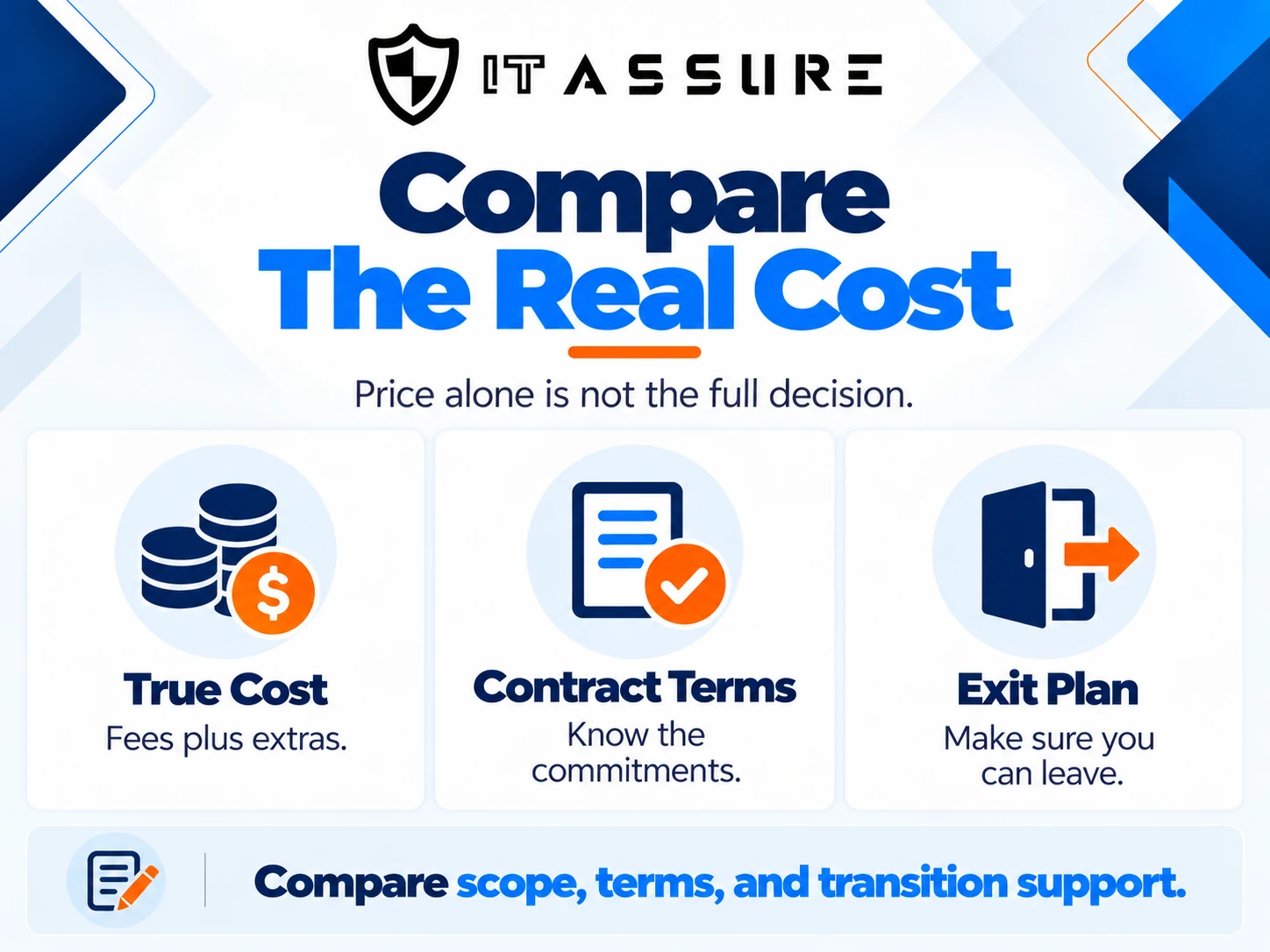
Consider the complete expected cost, including recurring fees, onboarding, licensing, additional users or devices, after-hours work, projects, emergency support, and separately billed remediation.
Understand how costs change as your organization grows and what circumstances allow the provider to revise its fees.
For a more detailed explanation of the cost structure, see MSP Pricing Explained: What Drives the Cost and How to Compare Quotes.
Read the Agreement Before Making the Decision
The written contract should answer the same questions discussed during the evaluation.
Confirm the service scope, exclusions, response commitments, customer obligations, payment terms, contract duration, renewal provisions, liability limitations, and procedures for handling additional work.
Then consider an issue that is easy to overlook during a promising new relationship: what happens if you decide to leave?
Who owns the administrative accounts, licenses, configurations, documentation, and data? What assistance will be provided during a transition? How will access be transferred or removed? What fees or notice periods apply?
A good service relationship should be built on continued value, not on a customer's inability to change providers.
A longer contract may be reasonable when it supports meaningful commitments or better economics. A shorter agreement may provide valuable flexibility. Neither is inherently superior.
What matters is that you understand the trade-offs before signing.
Make the Decision Based on Evidence, Not Just Promises
Once you've narrowed your choices, use the same evaluation criteria for each provider.
| Evaluation area | What to establish |
|---|---|
| Business fit | Can the provider demonstrate understanding of your operations and needs? |
| Service responsibility | Is the included work clearly defined, including exclusions and your team's obligations? |
| Delivery consistency | Can the provider explain its procedures and demonstrate how it handles problems? |
| Cybersecurity | How are protections monitored, coverage verified, gaps corrected, and incidents handled? |
| Cost and terms | Are the complete fees, assumptions, service commitments, and contract terms understandable? |
| Transition | Can you retain control of your systems and move to another provider when necessary? |
A provider does not have to be the largest, offer every possible service, or use the most impressive technology to be a good choice.
The right provider is one whose capabilities match your needs, whose responsibilities are clearly understood, and whose service model gives you confidence that the promised work can be delivered.
If you already have capable IT support, the answer may be to improve the existing arrangement or add a focused cybersecurity service—not replace everything.
If your current provider is meeting your needs and can demonstrate the necessary work, staying with it may be the best decision.
The purpose of the evaluation is not to find reasons to switch. It is to make an informed choice.
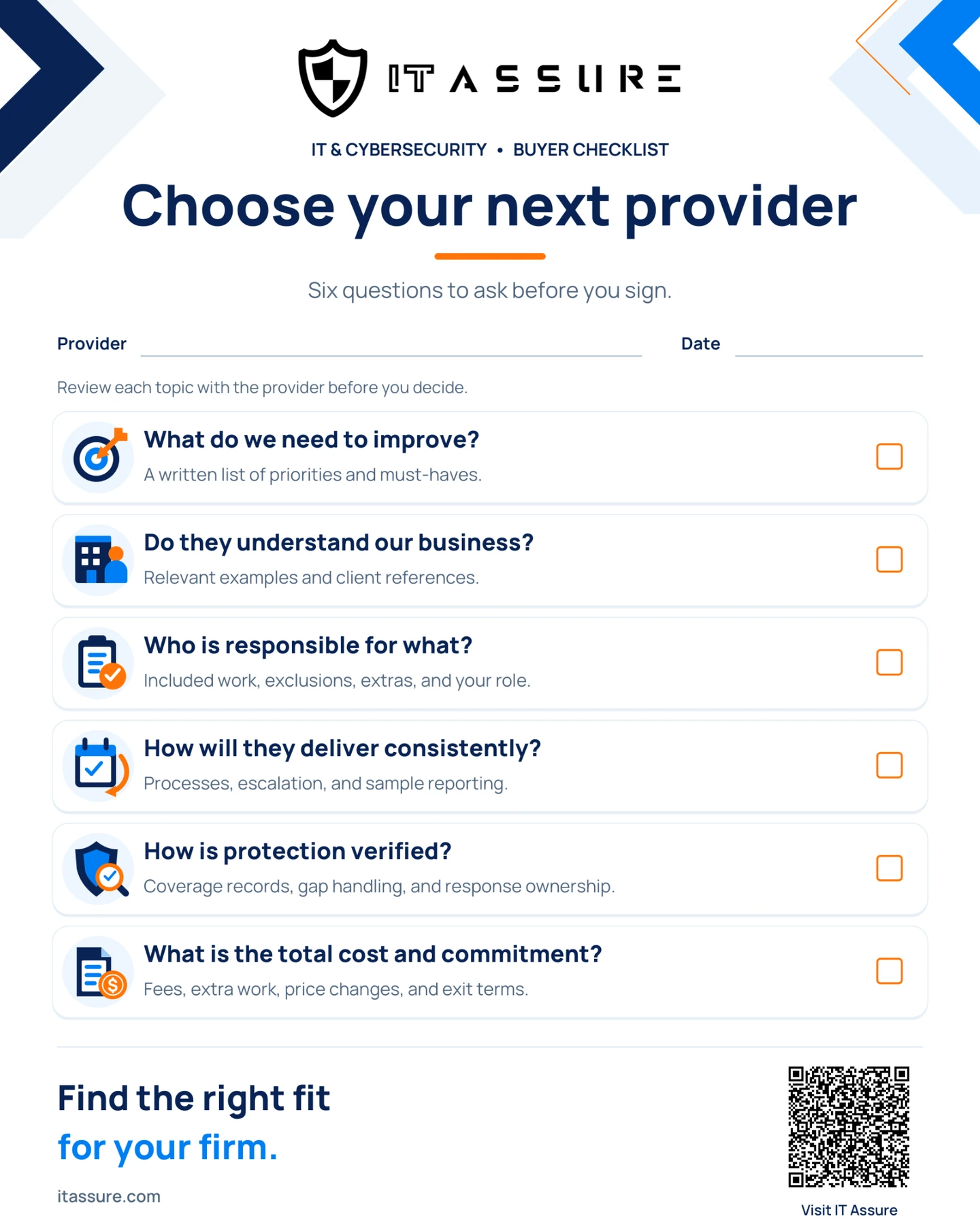
Take the provider-selection checklist with you
Use this one-page worksheet in your next provider meeting. Record the provider and date, then work through six questions about your priorities, business fit, responsibility, delivery, protection, and total commitment.
Save the checklist as an image (PNG)
One page. No form required. Print it or keep a copy for your evaluation.
Before choosing a provider, ask one final question:
If something important fails six months from now, will we know who is responsible, what they will do, and how we will know the problem has been resolved?
If the answer is clear, supported by evidence, and reflected in the agreement, you're in a much stronger position to make the decision.
If cybersecurity responsibilities are one of the areas you are trying to clarify, see what happens in IT Assure's Cybersecurity Review.