
By Mark Su ·
A practical guide to the work, overlap, and choices behind MSP and MSSP services.
Your IT support is responsive. Employees can work. Then a client security questionnaire asks who investigates suspicious account activity and who can act when something is wrong.
Do you need another service—or a clearer understanding of the one you already have?
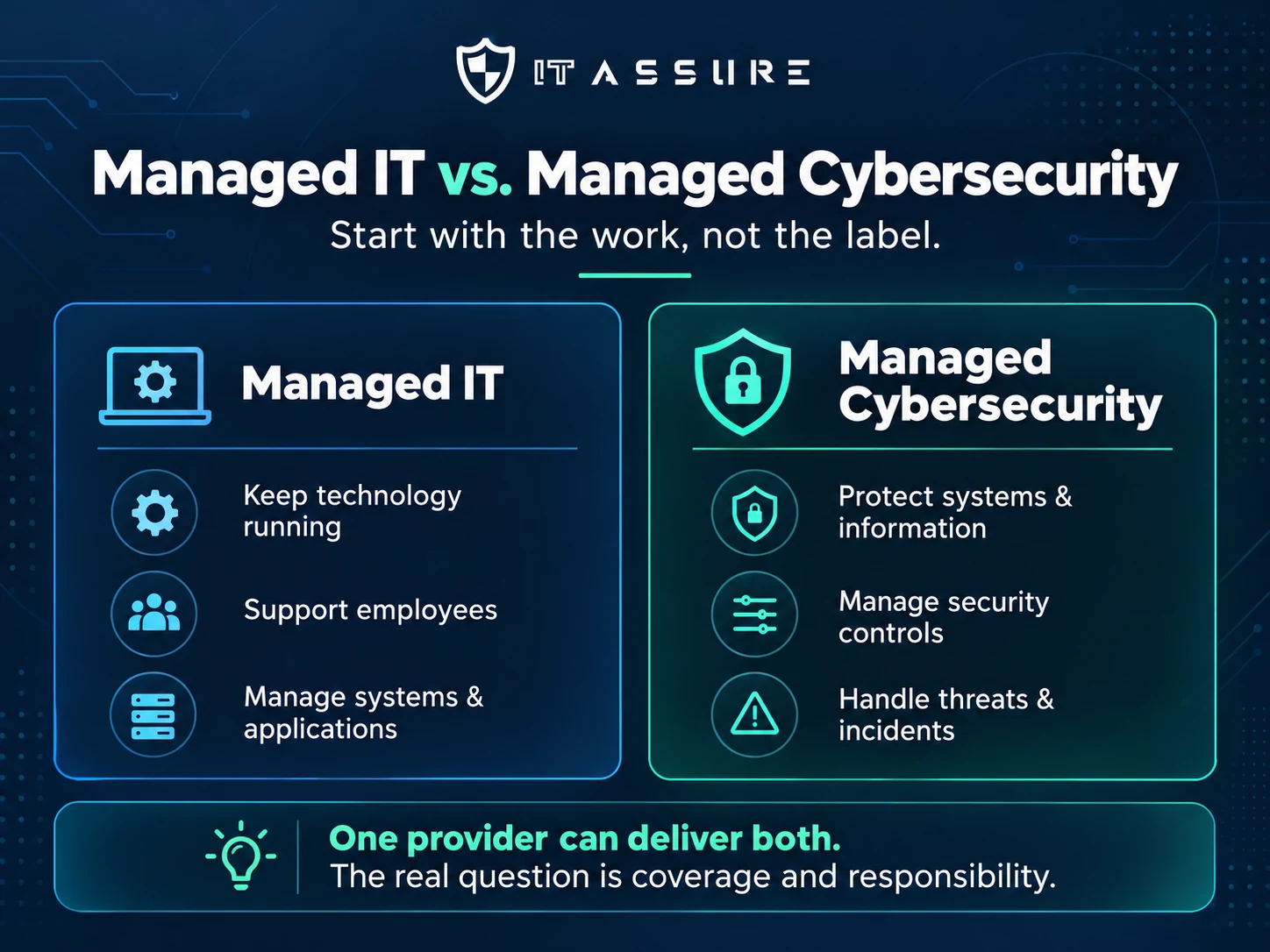
Managed IT services focus on operating and supporting business technology. Managed cybersecurity services focus on managing agreed security protections and cyber risks around that technology.
The services overlap, and one provider can deliver both. (GOV.UK)
Choose the arrangement that fills an identified capability gap while preserving what already works.
Managed IT and managed cybersecurity: what the labels mean
MSP stands for managed service provider. MSSP stands for managed security service provider.
In this comparison, “managed IT” describes the operational support function, while “managed cybersecurity” describes the security-focused function. The written scope establishes what each provider actually delivers. (Australian Cyber Security Centre)
| Function | Typical focus |
|---|---|
| Managed IT | Keep technology running, support employees, and manage systems and applications. |
| Managed cybersecurity | Protect systems and information, manage security controls, and handle threats and incidents within the agreed scope. |
These are possible service components, not automatic inclusions. A provider may combine operational and security capabilities within the same agreement. (GOV.UK)
The overlap matters
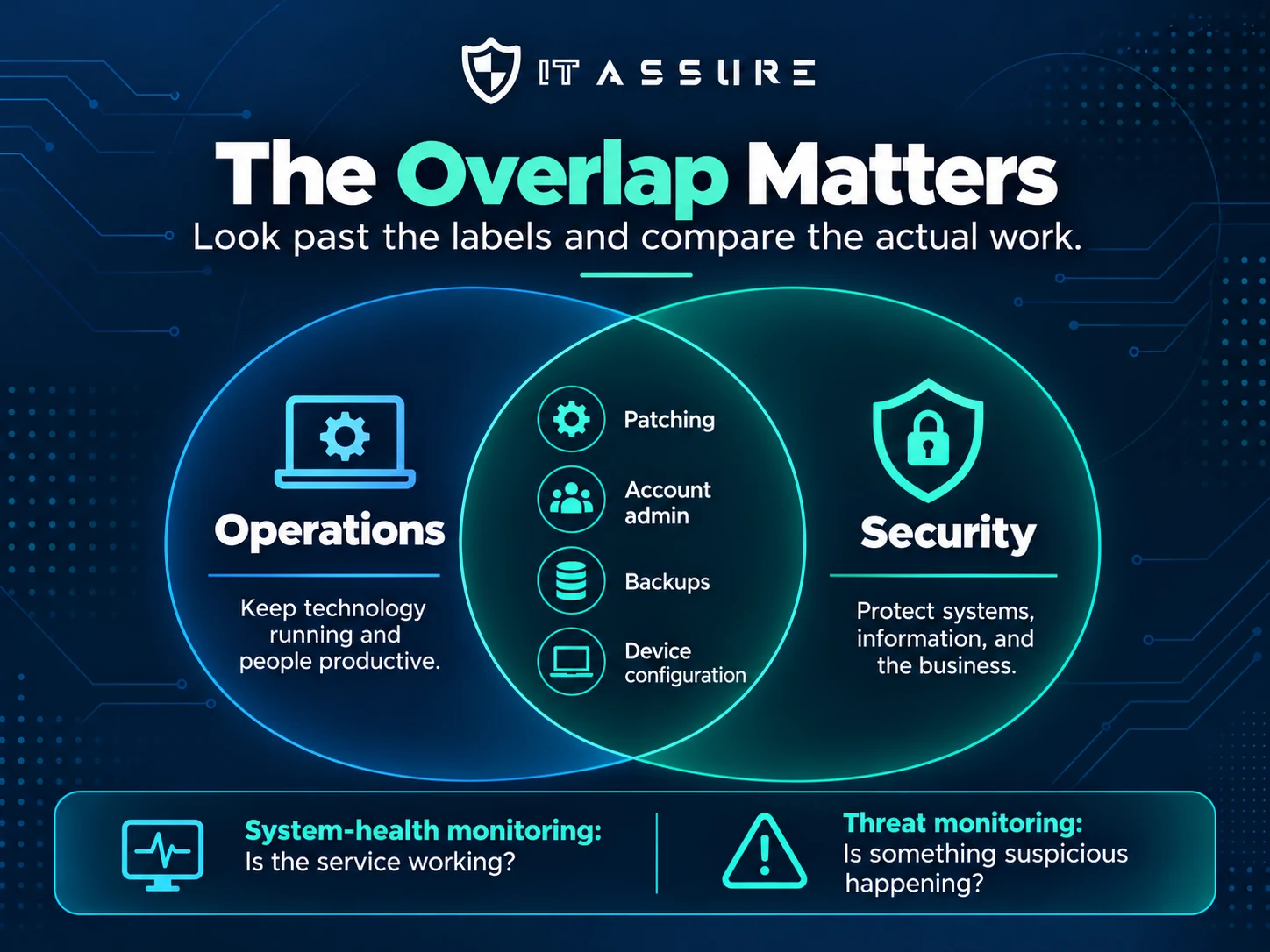
Patching, account administration, backups, and device configuration can support both operations and cybersecurity.
Updating a computer may improve reliability and address a vulnerability. Creating an account involves making access available and applying the permissions and authentication that protect it.
That is why “our MSP handles security” deserves a concrete explanation of the work involved. A capable managed IT provider may already deliver the cybersecurity functions your business needs.
The same scrutiny applies to a specialist security proposal: establish the particular systems, controls, and activities covered. (Australian Cyber Security Centre)
Consider the difference between “Is the service available?” and “Is someone using this account in an unexpected or unauthorized way?”
Both questions matter. Ask which signals are monitored, who reviews findings, and what action follows. That turns a broad promise of “monitoring” into something you can evaluate. (Questions to ask managed service providers)
Evaluate cybersecurity from prevention to recovery
Cybersecurity includes work before, during, and after an incident. NIST organizes cybersecurity risk management into six functions: Govern, Identify, Protect, Detect, Respond, and Recover.
For a buyer, this means looking beyond the list of security products.

- Prevention and ongoing improvement can include identifying weaknesses, prioritizing updates, strengthening configurations, and reviewing access.
- Detection involves recognizing and investigating signs that something may be wrong.
- Response involves decisions and actions to manage an incident, including containment.
- Recovery addresses restoring affected systems and operations.
Source: NIST Cybersecurity Framework 2.0 Small Business Quick Start Guide
Translate those stages into specific questions for a proposal. Who investigates an alert? Who can isolate a device or disable an account? Who addresses the underlying issue, and who restores affected services?
Also distinguish monitoring hours from the availability of people authorized to respond. Ask how nights, weekends, escalation, and separately charged incident work are handled.
An alert, a containment action, and a completed recovery are different deliverables. Your agreement should make the included work clear. (National Cyber Security Centre)
Which arrangement fits your business?
Start with the outcome your business needs and the capabilities already available. The following is a practical decision aid, rather than a rule that one provider category is always preferable.

| What needs strengthening? | Arrangement to evaluate |
|---|---|
| Dependable support and administration | Managed IT |
| Security follow-through while IT operations work well | Managed cybersecurity |
| Both operations and security management | Coverage for both functions |
| One specific requirement needing specialist expertise | A specialist project |
Sensitive client information, remote working, growth, insurance questions, and contractual requirements can help define the capabilities you need. Treat them as inputs to the decision, rather than automatic reasons to purchase an additional package.
Having both functions covered does not necessarily mean buying two contracts.
A single provider can simplify the number of relationships you manage. Evaluate its capability and service commitments across both functions.
A shared arrangement can preserve effective IT support while adding security expertise or capacity. It also requires clear coordination.
A useful way to evaluate co-managed cybersecurity is to compare the proposed service’s defined scope with your existing responsibilities, tools, and access arrangements. Confirm how the services will work together and what changes implementation requires.
Choose the simplest arrangement that credibly covers the required work and makes responsibility clear.
A new employee: who does what?
Consider this illustrative scenario.
An employee receives a laptop, an email account, and access to business applications.
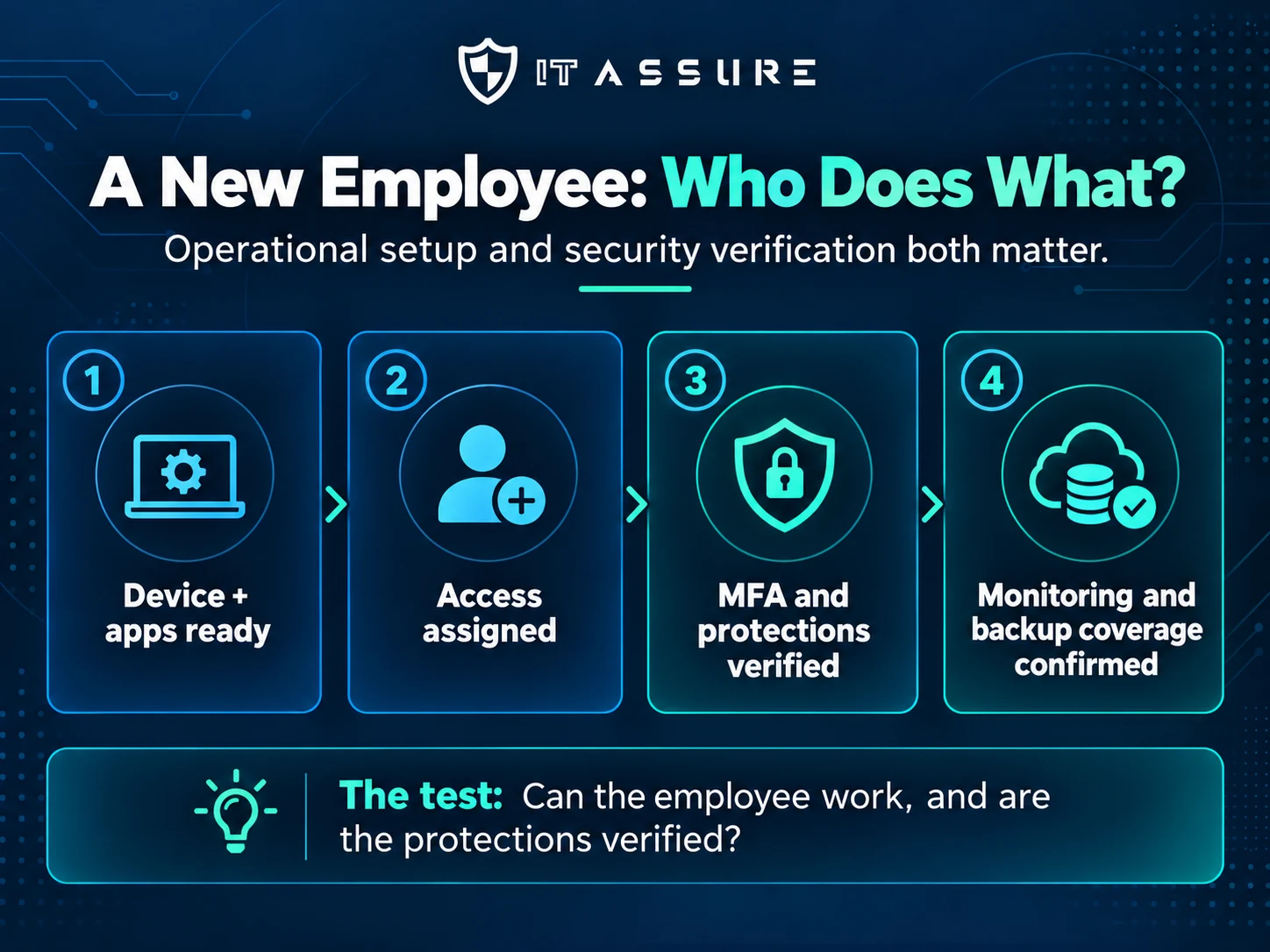
The operational work includes configuring the equipment, assigning software, and helping the employee start work.
The security work includes applying approved access permissions, enforcing required authentication, verifying endpoint protection and encryption, and confirming the agreed monitoring and backup coverage.
One team may complete all of this, or several parties may share it. The completion test stays the same:
Can the employee perform the required work, and have the agreed protections been verified?
For a shared arrangement, record who performs each step, who approves it, and who verifies completion. Use the same approach for departures, replacement devices, and significant configuration changes.
Make response authority explicit
Clear responsibility becomes especially important during an incident.
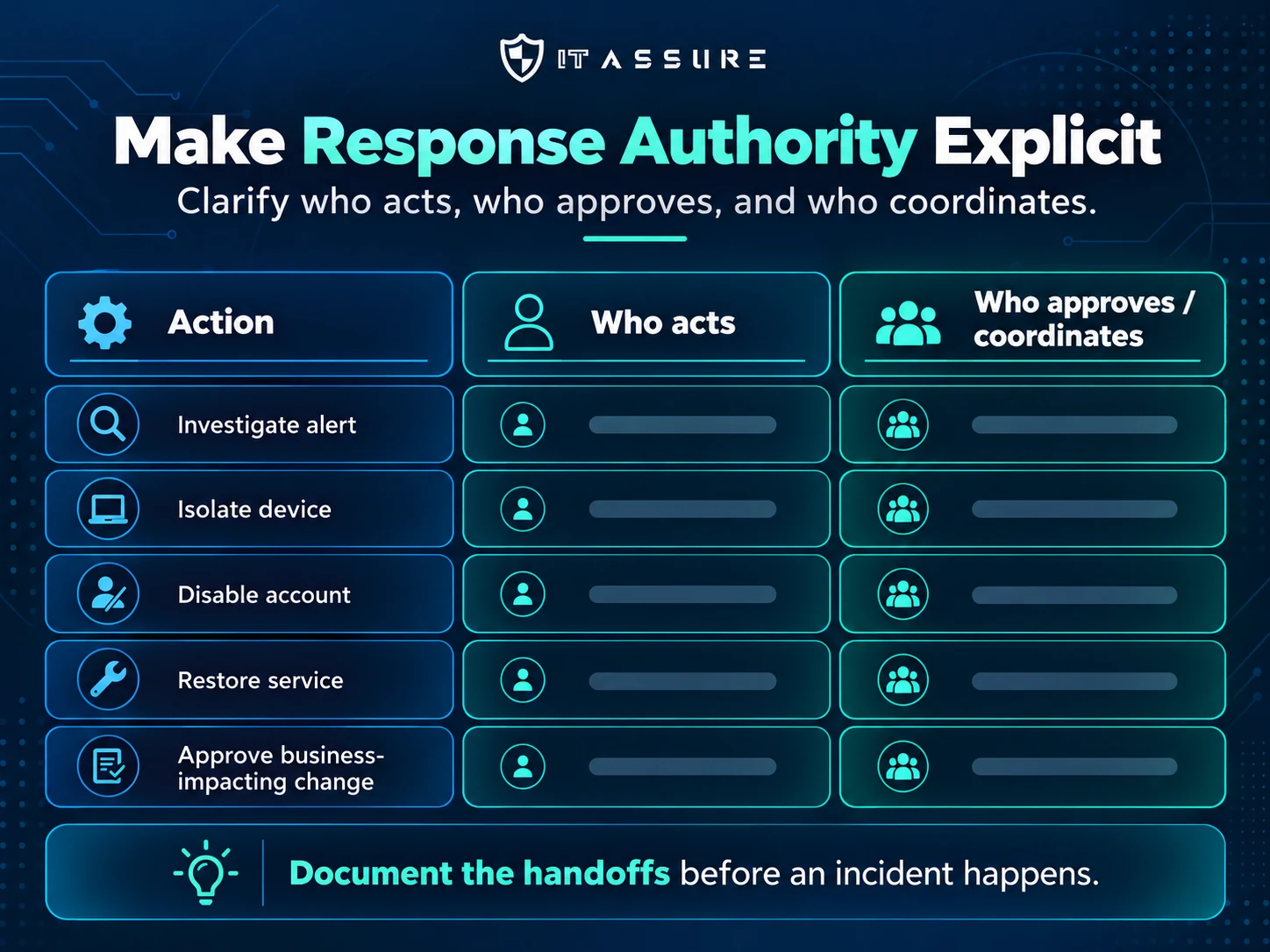
The technical team may recommend isolating a computer or restricting access to an application. Leadership needs an agreed way to authorize business-impacting decisions, with preapproved actions where appropriate.
Establish who leads the response, who coordinates other providers, and how information reaches the business. Define the internal responsibilities that continue alongside the managed service, including access decisions, staff cooperation, and approval of additional work. (NIST Computer Security Resource Center)
Use the worksheet above to identify who acts and who approves or coordinates each action: investigate an alert, isolate a device, disable an account, restore a service, and approve a business-impacting change.
Also review how providers protect their own access to your systems. Privileged access, authentication, activity logging, and incident notification are relevant to either arrangement. (Australian Cyber Security Centre)
Compare the total commitment
Managed IT and managed cybersecurity can use similar per-user or per-device charges while covering different work.
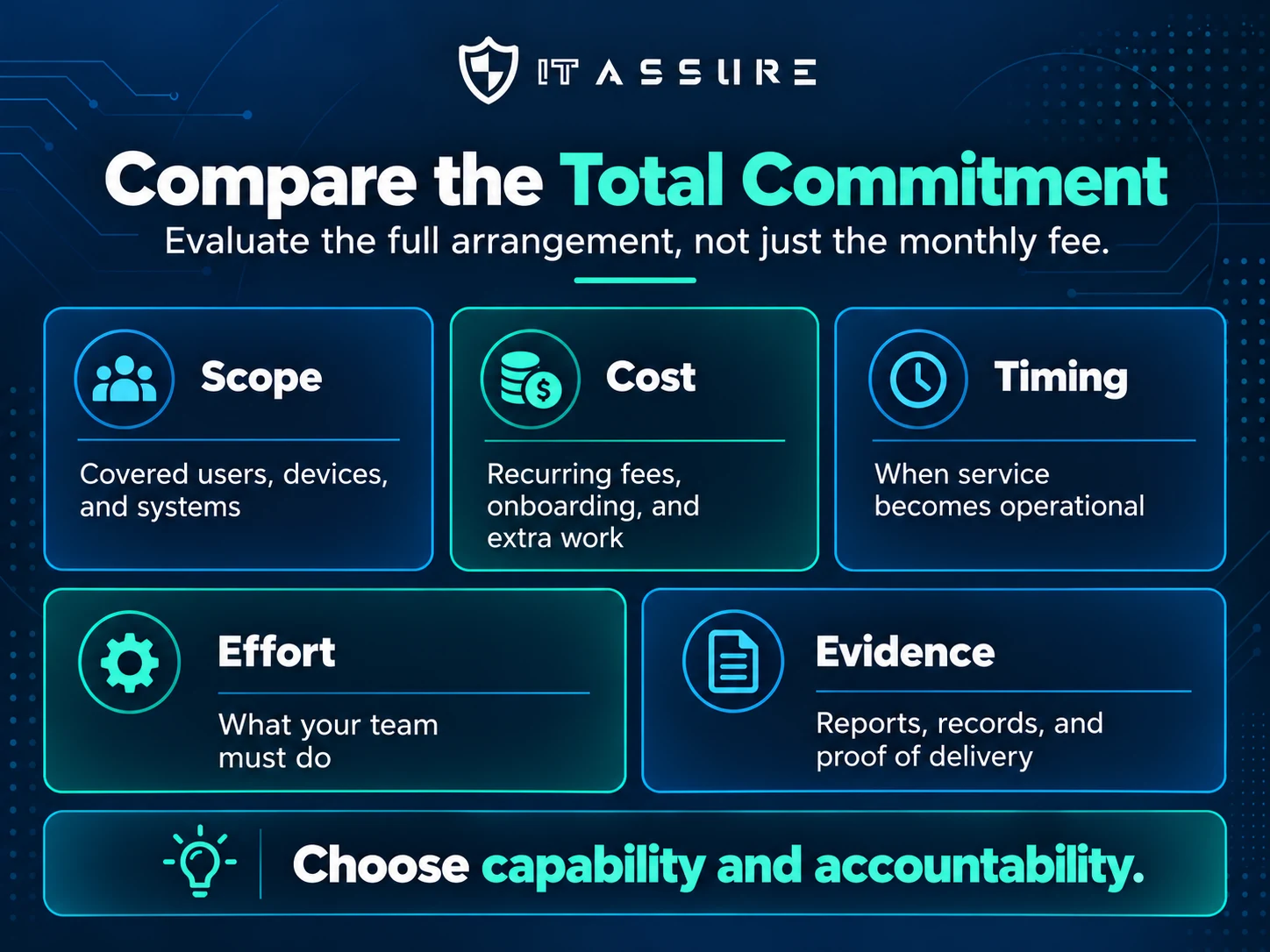
Compare the whole arrangement: recurring fees, onboarding, separately scoped work, incident assistance, and the activities retained by your team. The complexity of the environment and the expertise and time required also help explain differences between proposals. See MSP Pricing Explained for a closer look at those costs.
Consider timing and effort alongside the financial cost. Ask when the agreed service becomes operational, what the first useful deliverable will be, what implementation changes are required, and how much participation is expected.
For evidence, request an appropriate redacted report, correction record, or relevant reference. Match the evidence to the capability being promised. (Australian Cyber Security Centre)
Start with the work your business needs
The strongest choice starts with a clear picture of the work.
When IT operations are effective and cybersecurity needs strengthening, preserve the effective arrangement and evaluate the additional capability.
When both need attention, establish coverage for both. When the current team already handles both well, build on that relationship.
Before your next renewal or proposal meeting, ask your team and provider to document the covered work, responsible parties, service commitments, and evidence of completion. Then identify the specific improvement any new service would provide.
What work does our business need performed, who is equipped and authorized to perform it, and how will we know it has been done?
For a provider-specific example of a defined managed-security scope, see Cyber Defensibility.

