

By Mark Su·
A buyer’s guide to managed IT and managed cybersecurity fees.
Two proposals cover the same number of employees, yet the monthly prices are different. How do you decide which represents better value?
Start with the work behind the number.
A per-user or per-device rate tells you how a bill is calculated. A useful comparison also considers the tools included, the expertise required, the work performed regularly, and the response when something goes wrong.
Compare the price for a defined service, with clear assumptions about workload and responsibility.
Start with what the price measures
A managed service provider, or MSP, may charge by user, device, a defined service package, or hours worked.
Clarify what each billable unit includes. For a per-user quote, ask how multiple computers, shared devices, servers, and temporary employees are handled. For a device-based quote, establish which equipment is counted.
Also separate the billing unit from the charging model. A service can be billed per user and delivered for a recurring fee covering agreed work. The monthly total can change when the number of billable users changes.
Managed IT and managed cybersecurity proposals may use similar billing units while covering different work. Establish the service scope before comparing their rates.
What sits behind the price
Your provider’s delivery costs can be understood through four practical components:
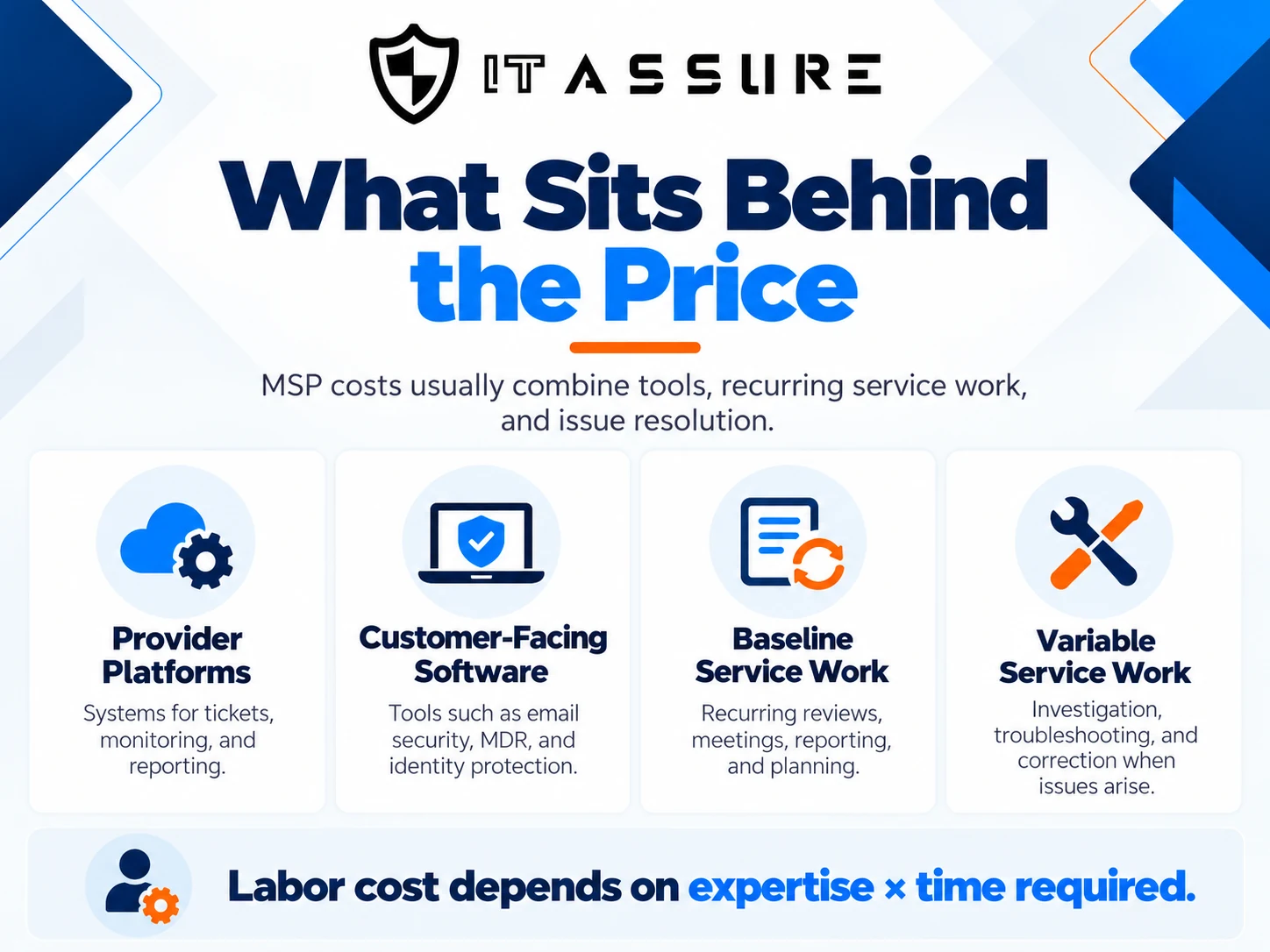
View the detailed cost-component comparison
| Component | What it supports | What influences the cost |
|---|---|---|
| Provider platforms | Systems used to organize service requests, monitor equipment, and produce reports. | Platform licensing and the scale of the supported operation. |
| Customer-facing software | Products used in the service, such as email security, managed detection and response, or identity protection. | Products included and the users, devices, or accounts licensed. |
| Baseline service work | Recurring account reviews, scheduled meetings, reporting, and planning. | The agreed activities and how often they occur. |
| Variable service work | Investigation, troubleshooting, and correction when issues arise. | The frequency and complexity of issues, time required, and expertise involved. |
This is a practical way to understand delivery, rather than a formal accounting classification.
For labor, two things matter together: the cost of the expertise and the time needed to perform the work. A useful simplified relationship is:
Labor cost = cost per hour of the people doing the work × hours required.
This describes delivery labor cost; the hourly rate charged to a customer is a separate figure. Selling prices also need to account for wider operating expenses and profit. Use the cost model to ask informed questions about a quote, rather than calculate an exact “fair price” from a software list.
Why another employee can change the cost differently
Adding employees or computers can increase software requirements and support demand. The effect on every activity is different.
A scheduled account-review meeting may require similar time after a modest increase in staff. Troubleshooting demand may change more substantially. A new office or a more complex application environment may also increase the baseline coordination required.

Think of “fixed time” as relatively stable work within the agreed arrangement. Variable time responds to changing demand.
The useful question is: “Which parts of our fee change as we grow, and what triggers those changes?”
Understand how the charging model handles workload
Recurring fixed fee. You pay an agreed recurring amount for a defined service. Within that scope, the provider plans for a workload that can vary between periods. Clarify the service commitments, separately charged work, and circumstances that allow a price review.
Hourly service. Charges follow the time spent at the agreed rates. Ask about minimum charges, approval thresholds, and the reporting you receive on completed work.
Blocks of hours. You purchase an allowance of service time. Confirm what counts against it, how usage is reported, whether unused hours carry forward, and the rate after the allowance is used.

The right arrangement depends on the work you need handled and how you prefer to manage spending uncertainty.
The important assumption inside a fixed fee
A fixed fee can cover a workload that changes from month to month.
When troubleshooting is included, the provider must estimate how much work the environment will require. That makes the condition and complexity of the environment relevant alongside its size.
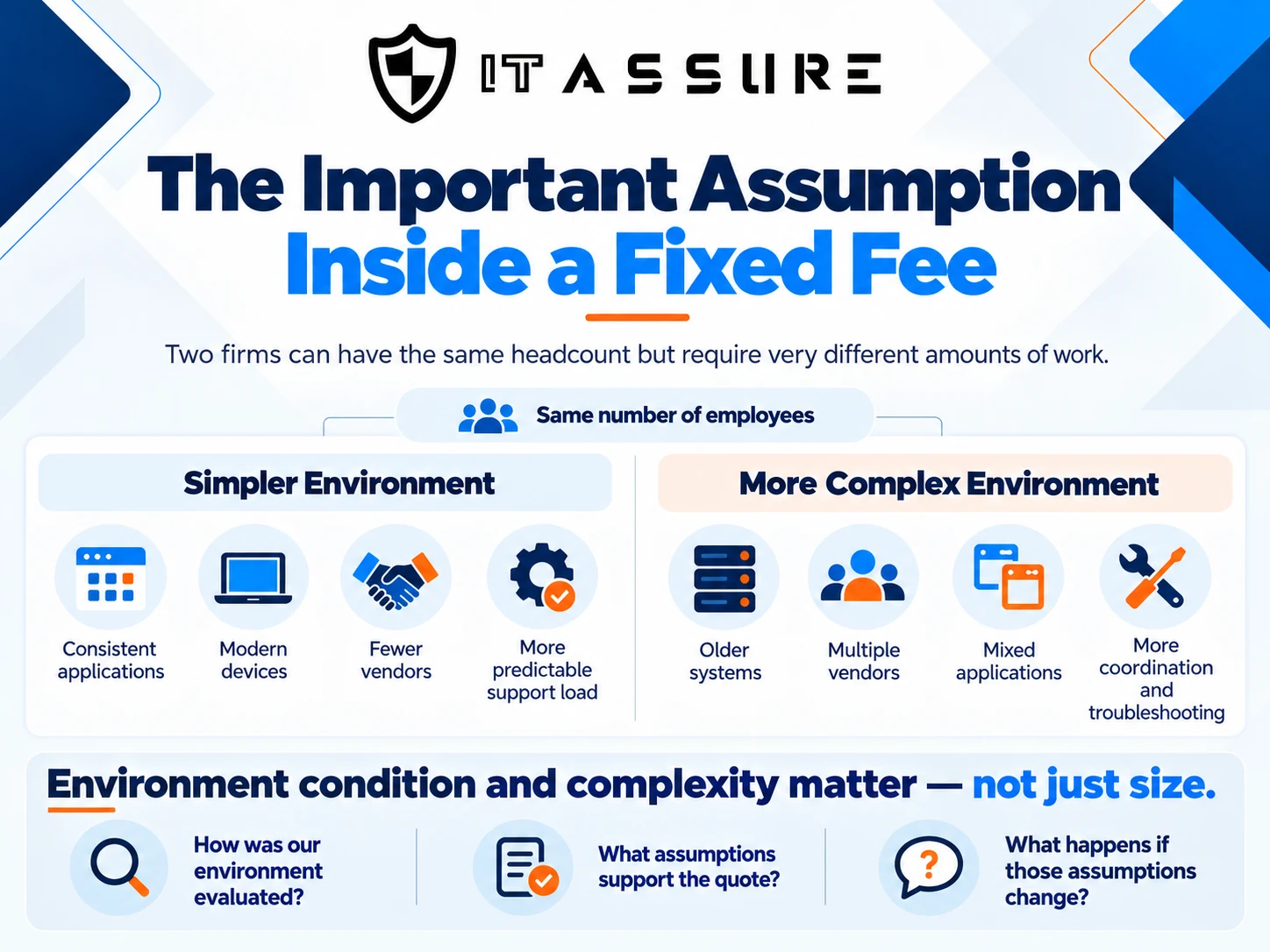
Consider an illustrative comparison: two firms have the same number of employees. One uses a consistent set of applications and devices. The other supports several older systems and requires coordination among multiple vendors. The work required may differ even at the same headcount.
Ask how the provider evaluated your environment, which assumptions support the quote, and what happens when those assumptions change.
A higher estimate deserves an explanation of the additional work or service commitment. A lower estimate deserves the same review of scope and assumptions.
Fewer repeat problems can benefit both sides
Your provider’s time is important, but so is your team’s.
Preventive work can reduce recurring problems and the time spent resolving them. In a fixed-fee arrangement, that can benefit the provider through more efficient delivery and the customer through fewer interruptions.
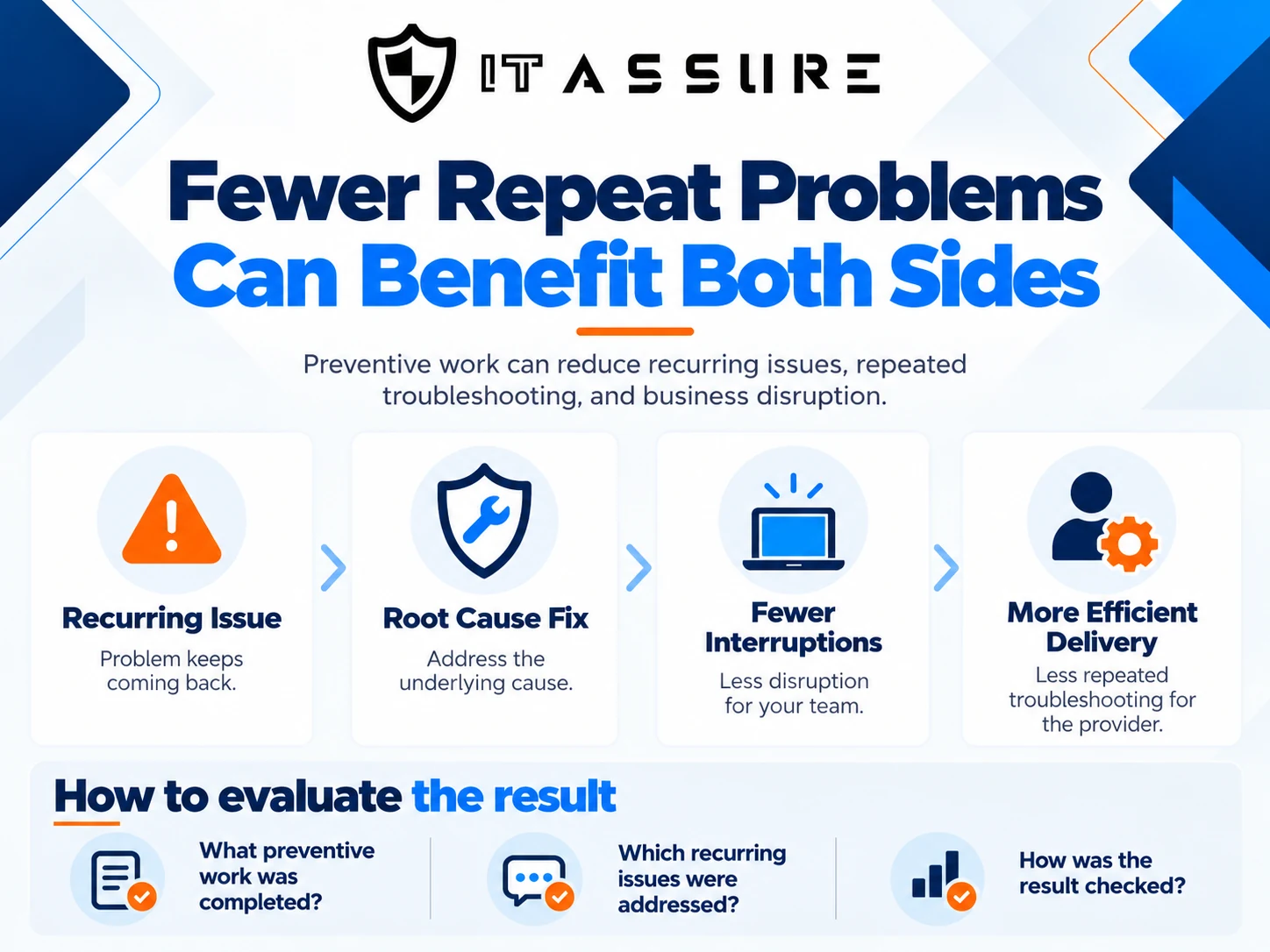
Illustrative example: resolving the underlying cause of a recurring issue can save repeated troubleshooting and repeated disruption to employees.
Evaluate the result as well as the activity. Ask what preventive work was completed, which recurring issues were addressed, and how the provider checked the result.
A quieter month is easier to interpret alongside a record of maintenance, unresolved issues, and completed corrections. Any reduction in your service fee follows the pricing terms; improved efficiency may instead show up as a more dependable working environment.
Use the same questions for every proposal
Put the answers side by side before comparing totals.
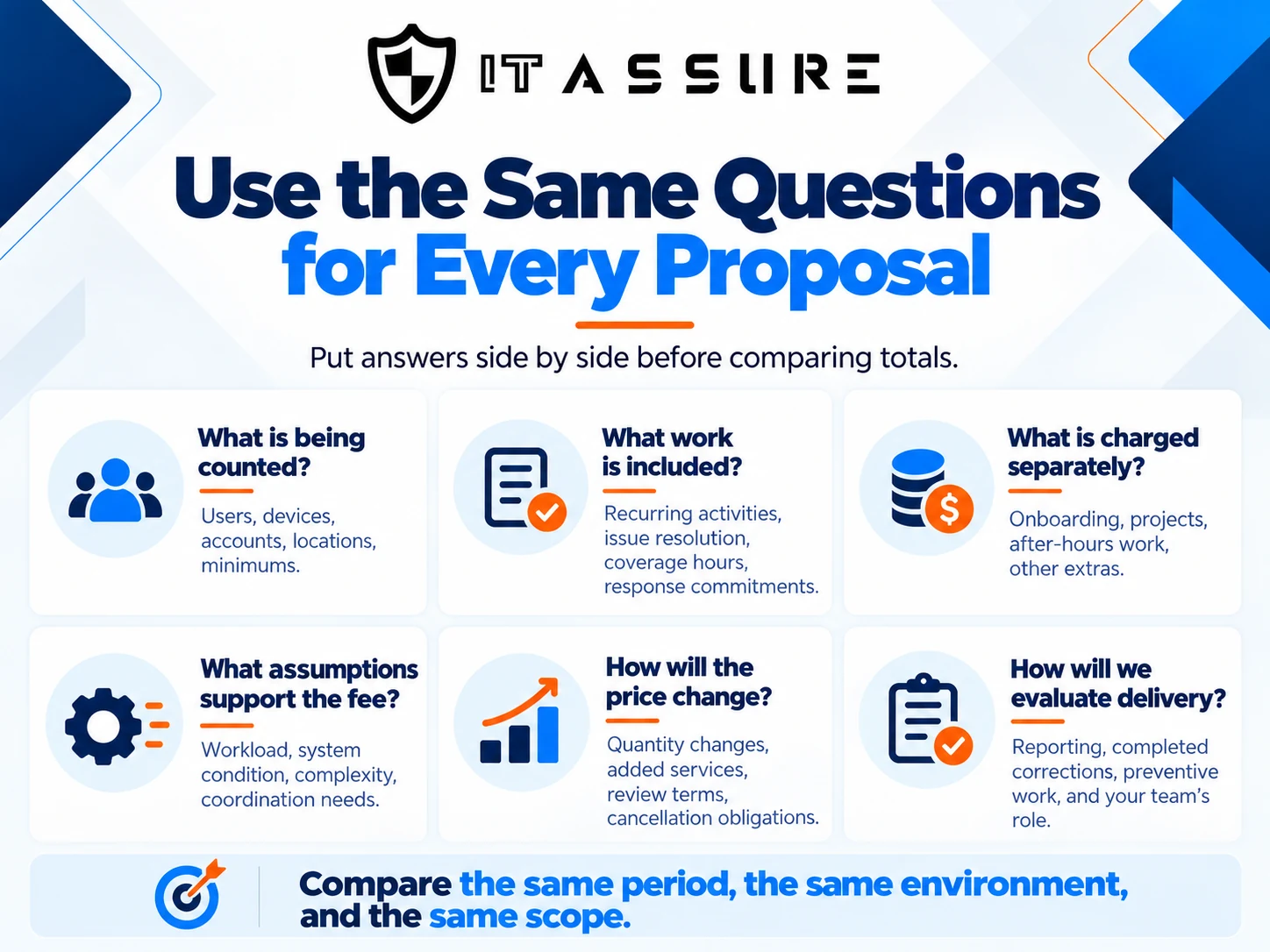
View all seven proposal-comparison questions, including timing
| Question | What to establish |
|---|---|
| What is being counted? | Included users, devices, accounts, locations, and any minimum quantities. |
| What work is included? | Recurring activities, issue resolution, coverage hours, and response commitments. |
| What is charged separately? | Onboarding, projects, after-hours work, and any other separately priced services. |
| What assumptions support the fee? | Expected workload, system condition, complexity, and coordination requirements. |
| How will the price change? | Quantity changes, additional services, price-review terms, and cancellation obligations. |
| How will we evaluate delivery? | Reporting, completed corrections, preventive work, and the participation expected from your team. |
| When should useful progress become visible? | Onboarding milestones, timing, dependencies, and how results will be checked. |
For budgeting, compare the same period and environment. Add recurring fees, one-time charges, and known additional work. Identify uncertain costs and the process for approving them.
Then consider the work and decisions that remain with your team.
Choose a price you can understand
A useful proposal makes three things clear: what your business receives, what it will pay, and how changing needs will be handled.
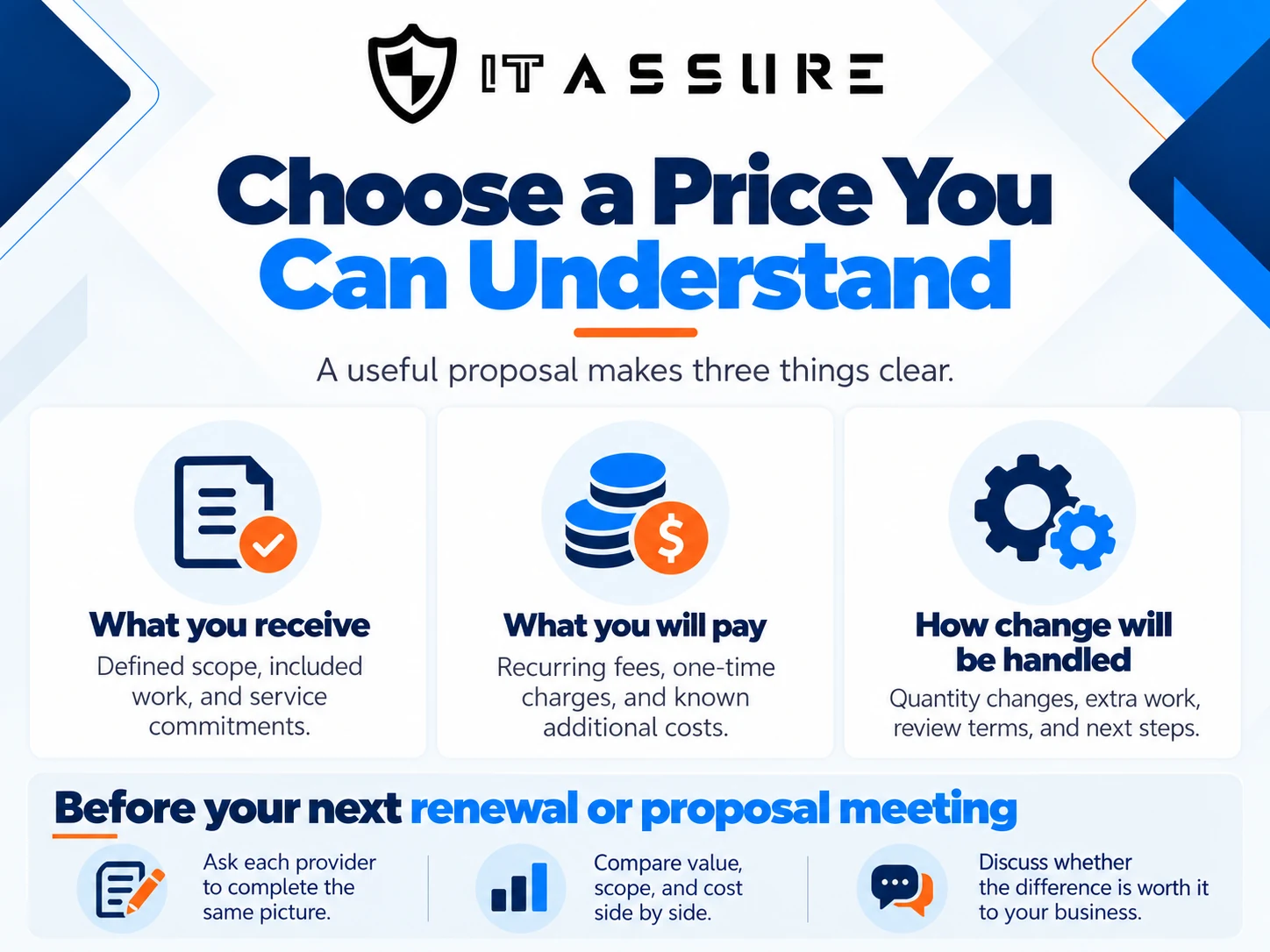
Assess whether any additional work, capability, or service commitment is worth the price difference to your business.
Before your next renewal or proposal meeting, take the comparison questions above and ask each provider to complete the same picture. You will have a stronger basis for discussing value, scope, and cost.
Provider-specific example: IT Assure’s managed cybersecurity plans and pricing.

